

Construction Method for Bentonite Waterproofing Blankets
Release date:
2016-12-09
A bentonite waterproof blanket is a geosynthetic material specifically designed for seepage control in artificial lake landscapes, landfill sites, underground parking garages, rooftop gardens, ponds, oil storage facilities, and chemical storage yards. It is manufactured by sandwiching highly swellable sodium‑based bentonite between specially engineered composite geotextiles and nonwoven fabrics. The needle‑punched bentonite impermeable mat creates numerous microscopic fiber spaces, preventing the bentonite particles from migrating in any single direction. Upon contact with water, it forms a uniform, high‑density gel‑like waterproof barrier within the mat, effectively inhibiting water infiltration.
A bentonite waterproof blanket is a geosynthetic material specifically designed for seepage control in artificial lake landscapes, landfill sites, underground parking garages, rooftop gardens, ponds, oil storage facilities, and chemical storage yards. It consists of highly swellable sodium‑based bentonite sandwiched between specially engineered composite geotextiles and nonwoven fabrics. Produced via needle‑punching, this bentonite impermeable mat creates numerous microscopic fiber spaces that prevent bentonite particles from migrating in any single direction. Upon contact with water, it forms a uniform, high‑density gel‑like waterproof barrier within the mat, effectively preventing water infiltration.
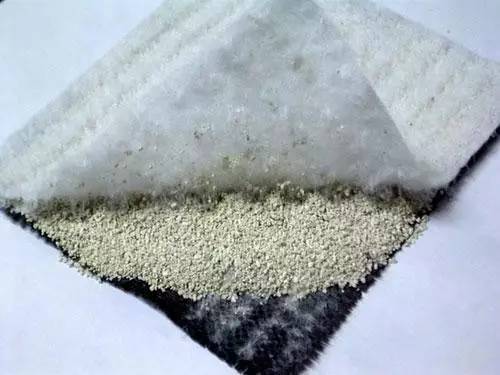
GCL is an impermeable liner that falls between GCL (in-situ thick compacted clay liners) and polymeric materials—geomembranes.
It is primarily used in environmental engineering projects such as waste landfills, underground water reservoirs, and underground infrastructure construction to address sealing, isolation, and seepage‑prevention challenges, delivering excellent performance and strong resistance to damage.
Bentonite waterproofing blankets can be classified according to their manufacturing processes into: needle-punched sodium‑based bentonite waterproofing blankets, needle‑punched laminated sodium‑based bentonite waterproofing blankets, and adhesive‑bonded sodium‑based bentonite waterproofing blankets.
The needle-punched laminated sodium‑based bentonite waterproofing blanket is manufactured by laminating a high‑density polyethylene geomembrane onto the outer surface of the nonwoven geotextile layer of a needle‑punched sodium‑based bentonite waterproofing blanket.
The adhesive‑bonded sodium‑based bentonite waterproofing blanket is produced by bonding bentonite particles to a high‑density polyethylene sheet using an adhesive, resulting in a compacted sodium‑based bentonite material.
Construction Methods for Bentonite Waterproofing Blankets
1. Bentonite waterproofing blankets are relatively heavy; it is recommended to use a loader in conjunction with specialized lifting equipment for handling and installation.
2. The bentonite waterproofing blanket shall be joined by lapping.
3. When installing bentonite waterproofing blankets on slopes greater than 10%, the number of longitudinal overlaps should be minimized, and the blanket on the slope must extend at least 1,500 mm beyond the toe line. D. We will install the bentonite waterproofing blankets strictly in accordance with the installation design drawings submitted to the supervising engineer, unless otherwise directed by the owner or the supervisor.
4. No equipment used for laying bentonite waterproofing blankets shall be driven over the already installed geosynthetic materials. During installation of the bentonite waterproofing blanket, the outdoor air temperature must not fall below 0°C or exceed 40°C.
5. All exposed edges of the bentonite waterproofing blanket must be immediately weighted down with sandbags or other heavy objects to prevent the blanket from being blown by the wind or pulled out of the surrounding anchorage trench. The bentonite waterproofing blanket should not be unrolled in windy conditions to avoid being lifted by the wind.
6. The installation of the bentonite waterproof blanket must ensure direct contact with the underlying foundation, and any wrinkles must be eliminated. Any wrinkles, folds, or bulges may lead to similar issues in other geosynthetic materials within the soil layer. To prevent such problems, we will address them by re‑laying the bentonite waterproof blanket or by cutting and repairing it, in accordance with the technical specifications.
7. Equipment used for bentonite waterproofing blankets must be approved by the supervising engineer before it can be employed; the use of unshielded razors or “quick‑cut” knives is prohibited. Construction equipment that could damage the bentonite blanket must not be applied directly to the blanket. A feasible laying method is to operate a bulldozer in reverse, using the front blade to spread the bentonite blanket. If the machine leaves tire tracks on the underlying soil, these must be restored to their original condition before resuming the installation work.
8. When installing bentonite mats, minimize dragging them across the foundation to avoid damaging the contact surface between the mat and the ground. If necessary, place a temporary geotextile layer on the ground to reduce abrasion‑induced damage during installation.
Under hydraulic pressure, sodium-based bentonite forms a high‑density impermeable barrier; at a thickness of approximately 3 mm, its permeability is less than &×10⁻¹¹ m/sec, equivalent to the compactness of 30 cm‑thick clay multiplied by a factor of 100, and it exhibits excellent self‑sealing water‑retention properties.
It has permanent waterproof performance.
Because sodium-based bentonite is a natural inorganic material, it does not degrade or corrode even after prolonged exposure or under changing environmental conditions, ensuring long-lasting waterproofing performance.
Easy construction and short project duration.
Compared with other waterproofing materials, GCL is relatively easy to install, requiring neither heating nor adhesive application. It is simply joined and secured using bentonite powder along with nails, washers, and other fasteners. After installation, no special inspections are needed, and any waterproofing defects can be readily repaired. Among existing waterproofing materials, GCL boasts the shortest installation time.
Unaffected by temperature
It will not become brittle and fracture even under cold climatic conditions.
Integration of waterproofing materials and substrates
When exposed to water, sodium‑based bentonite exhibits an expansion capacity of 20–28 times its original volume; even in the presence of vibrations and settlement in concrete structures, the bentonite within the GCL can self‑heal cracks on the concrete surface up to 2 mm wide.
Geosynthetic clay liner (GCL) is a novel geosynthetic material composed of a layer of bentonite or other low-permeability mineral material enclosed between a geotextile or geomembrane, manufactured through needle-punching or sewing. Our company utilizes highly swellable sodium‑based bentonite, which expands upon contact with water, undergoes hydration, and forms an impermeable gel. Additionally, this bentonite possesses excellent water‑retention capabilities, with an absorption capacity exceeding ten times its own weight.

Latest Updates


Phone:0534-7281652
Fax:0534-7281898
Email:haoyangjituan@126.com
Website:www.haoyanghuanjing.com
Address: No. 1567, Wenhua Street, National High-Tech Industrial Development Zone, Yucheng, Dezhou, Shandong Province
Reporting and Complaint Hotline:0534-7281652
Reporting and Complaint Email:haoyangjituan@126.com

Mobile access

Follow us
Copyright © HaoYang Environmental Co.,Ltd.